
- Release notes
- Getting started
- Installation
- Configuration
- Integrations
- Authentication
- Working with Apps and Discovery Accelerators
- AppOne menus and dashboards
- AppOne setup
- TemplateOne 1.0.0 menus and dashboards
- TemplateOne 1.0.0 setup
- TemplateOne menus and dashboards
- TemplateOne 2021.4.0 setup
- Purchase to Pay Discovery Accelerator menus and dashboards
- Purchase to Pay Discovery Accelerator Setup
- Input tables of Purchase-to-Pay Discovery Accelerator 21.10
- Input tables of Purchase-to-Pay Discovery Accelerator V. 21.4
- Adding automation estimates
- Order to Cash Discovery Accelerator menus and dashboards
- Order to Cash Discovery Accelerator Setup
- Basic Connector for AppOne
- SAP Connectors
- Introduction to SAP Connector
- SAP input
- Checking the data in the SAP Connector
- Adding process specific tags to the SAP Connector for AppOne
- Adding process specific Due dates to the SAP Connector for AppOne
- Adding automation estimates to the SAP Connector for AppOne
- Adding attributes to the SAP Connector for AppOne
- Adding activities to the SAP Connector for AppOne
- Adding entities to the SAP Connector for AppOne
- SAP Order to Cash Connector for AppOne
- SAP Purchase to Pay Connector for AppOne
- SAP Connector for Purchase to Pay Discovery Accelerator
- SAP Connector for Order-to-Cash Discovery Accelerator
- Superadmin
- Dashboards and charts
- Tables and table items
- Application integrity
- How to ....
- Working with SQL connectors
- Introduction to SQL connectors
- Setting up a SQL connector
- CData Sync extractions
- Running a SQL connector
- Editing transformations
- Releasing a SQL Connector
- Scheduling data extraction
- Structure of transformations
- Using SQL connectors for released apps
- Generating a cache with scripts
- Setting up a local test environment
- Separate development and production environments
- Useful resources
Process Mining user guide
Introduction
This section contains an overview of the attributes for each of the input tables of the Purchase-to-Pay Discovery Accelerator. For each entity the attributes are listed. For each attribute, the name and a data type are displayed. Apart from that, it is indicated whether the attribute is mandatory if the entity is included in the Purchase-to-Pay process.
| Entity | Table | Mandatory Y/N |
|---|---|---|
| Purchase requisition | Purchase_requisitions_base | N |
| Purchase order | Purchase_orders_base | Procurement: Y Accounts payable: N |
| Purchase order item | Purchase_order_items_base | Procurement: Y Accounts payable: N |
| Goods receipt | Goods_receipt_base | N |
| Invoice | Invoices_base | Procurement: N Accounts payable: Y |
| Invoice item | Invoice_items_base | Procurement: N Accounts payable: Y |
| Accounting | Accounting_documents_base | N |
| Payment | Payments_base | N |
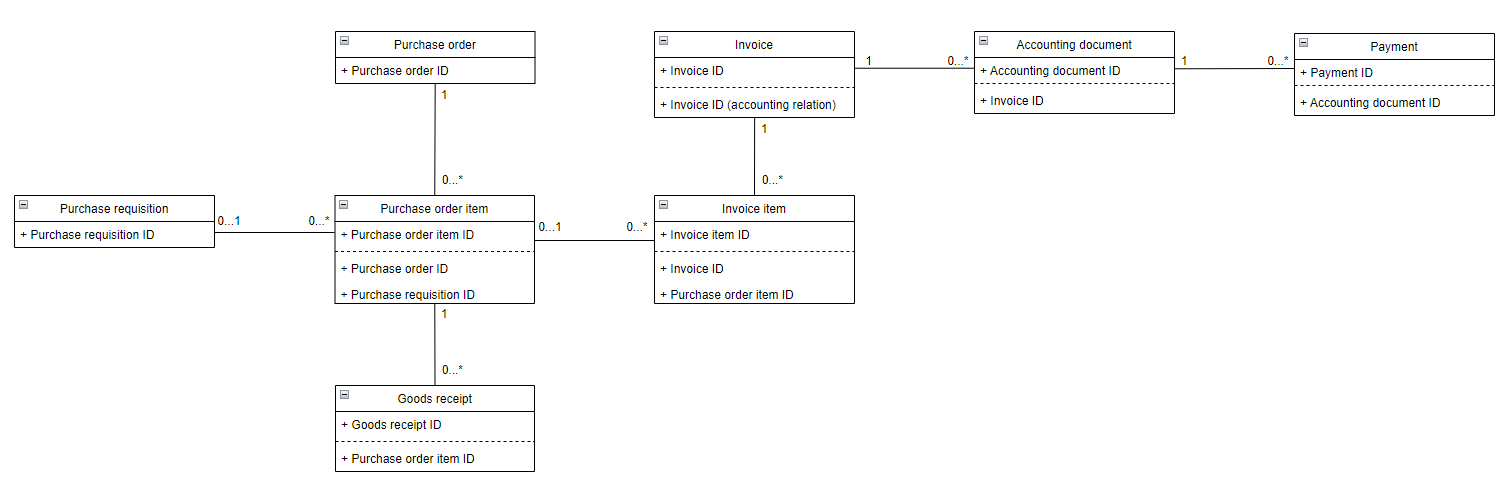
The illustration below displays the relations between entities of the Purchase-to-Pay Discovery Accelerator.
Purchase Requisition
Purchase_requisitions_base Table
Below is an overview of the attributes of the Purchase_requisitions_base table.
| Name | Data type | Mandatory Y/N | Description |
|---|---|---|---|
| Purchase requisition ID | Text | Y | The unique identifier of the purchase requisition. |
| Creation date | Date | Y | The date on which the purchase requisition is created. |
| Approval status | Text | N | The status of the purchase requisition in the process. For example, ‘open’, ‘closed’, ‘pending’, ‘approved’, etc. |
| Material | Text | N | The requested material. |
| Material group | Text | N | The categorization of the requested material. |
| Purchase requisition | Text | N | A user-friendly name to identify the purchase requisition. |
| Purchase requisition type | Text | N | The categorization of purchase requisitions. |
| Quantity | Text | N | The quantity and the unit of measurement requested. |
| Requisitioner | Text | N | The person who requested the purchase requisition |
| Value | Double | N | A monetary value related to the purchase requisition |
Purchase Order
Purchase_orders_base Table
Below is an overview of the attributes of the Purchase_orders_base table.
| Name | Data type | Mandatory Y/N | Description |
|---|---|---|---|
| Purchase order ID | Text | Y | The unique identifier of the purchase order. |
| Creation date | Date | Y | The date on which the purchase order is created. |
| Approval status | Text | N | The status of the purchase order in the process. For example, ‘open’, ‘closed’, ‘pending’, ‘approved’, etc. |
| Company | Text | N | The company for which the purchase order is created. |
| Purchase order | Text | N | A user-friendly name to identify the purchase order. |
| Purchase order creator | Text | N | The person who created the purchase order. |
| Purchase order type | Text | N | The categorization of purchase orders. |
| Purchasing group | Text | N | The purchasing group associated with the purchase order. |
| Purchasing organization | Text | N | The purchasing organization associated with the purchase order. |
| Supplier | Text | N | The supplier associated with the purchase order. |
| One time supplier | Boolean | N | An indicator if the supplier is a one time supplier. |
| Supplier country | Text | N | The country associated to the supplier. |
| Supplier region | Text | N | The region associated to the supplier. |
Purchase_order_items_base Table
Below is an overview of the attributes of the Purchase_order_items_base table.
| Name | Type | Mandatory Y/N | Description |
|---|---|---|---|
| Purchase order item ID | Text | Y | The unique identifier of the purchase order item |
| Purchase order ID | Text | Y | The unique identifier of the purchase order |
| Purchase requisition ID | Text | N* | The unique identifier of the purchase requisition. |
| Business area | Text | N | The business area associated with the purchase order item. |
| Cost center | Text | N | The cost center associated with the purchase order item. |
| Customer | Text | N | The customer on behalf of whom the purchase order item is created. |
| Customer country | Text | N | The country associated to the customer. |
| Customer region | Text | N | The region associated to the customer. |
| Delivery complete | Boolean | N | Indicator if all ordered goods are received. |
| Latest actual delivery date | Date | N | The latest actual delivery date for the purchase order item. |
| Latest expected delivery date | Date | N | The latest originally confirmed delivery date for the purchase order item. |
| Material | Text | N | The ordered materials. |
| Material group | Text | N | The categorization of the ordered materials. |
| Plant | Text | N | The plant associated to the purchase order item. |
| Purchase order item | Text | N | A user-friendly name to identify the purchase order item. |
| Quantity | Text | N | The quantity and the unit of measurement ordered. |
| Storage location | Text | N | The storage location associated to the purchase order item. |
| Value | Double | N | The monetary value related to the purchase order item. |
* If you want to include purchase requisition events in the process graphs, the Purchase requisition ID field is mandatory.
Goods_receipt_base
Below is an overview of the attributes of the Goods_receipt_base table.
| Name | Type | Mandatory Y/N | Description |
|---|---|---|---|
| Goods receipt ID | Text | Y | The unique identifier of the goods receipt. |
| Purchase order item ID | Text | N* | The unique identifier of the purchase order item. |
* If you want to include goods receipt events in the process graphs, the Purchase order item ID field is mandatory.
Invoice
Invoices_base Table
Below is an overview of the attributes of the Invoices_base table.
| Name | Type | Mandatory Y/N | Description |
|---|---|---|---|
| Invoice ID | Text | Y | The unique identifier of the invoice. |
| Invoice ID (accounting relation) | Text | N* | The unique identifier of the invoice as known in the accounting system. |
| Creation date | Date | Y | The date on which invoice was created in the system. |
| Baseline date | Date | N | The baseline date for due date calculation of the invoice. |
| Company | Text | N | The company associated with the invoice. |
| Discount percentage 1 | Double | N | The discount percentage for discount period 1. |
| Discount percentage 2 | Double | N | The discount percentage for discount period 2. |
| Discount period 1 | Integer | N | The payment period for which discount percentage 1 applies. |
| Discount period 2 | Integer | N | The payment period for which discount percentage 2 applies. |
| Fiscal year | Text | N | The fiscal year that the invoice belongs to. |
| Invoice | Text | N | A user-friendly name to identify the invoice. |
| Invoice creator | Text | N | The person who created the invoice. |
| Invoice date | Date | N | The date on which the received invoice was created. |
| Invoice type | Text | N | Categorization of invoices. |
| Net payment period | Integer | N | The net payment period for the invoice in days. |
| Payment method | Text | N | The payment method of the invoice. |
| Payment terms | Text | N | The payment terms applicable for the invoice. |
| Posting date | Date | N | The date on which the invoice was posted (accounting). |
* If you want to include accounts payable events in the process graphs, the Invoice ID field is mandatory.
Invoice_items_base Table
Below is an overview of the attributes of the Invoice_items_base table.
| Name | Type | Mandatory Y/N | Description |
|---|---|---|---|
| Invoice Item ID | Text | Y | The unique identifier of the invoice item. |
| Invoice ID | Text | N* | The unique identifier of the invoice. |
| Purchase order item ID | Text | N* | The unique identifier of the purchase order item. |
| Invoice item | Text | N | A user-friendly name to identify the invoice item. |
| Material | Text | N | The material invoiced. |
| Plant | Text | N | The plant associated to the invoice item. |
| Quantity | Text | N | The quantity and the unit of measure for the invoice item. |
| Value | Double | N | The monetary value of the invoice item. |
* If you want to include events related to accounts payable in the process graphs, the Invoice ID and Purchase order item ID fields are mandatory.
Accounting
Accounting_documents_base Table
Below is an overview of the attributes of the Accounting_documents_base table.
| Name | Type | Mandatory Y/N | Description |
|---|---|---|---|
| Accounting document ID | Text | Y | The unique identifier of the accounting document. |
| Invoice ID | Text | N* | The unique identifier of the invoice as known in the accounting system. |
* If you want to include events related to accounts payable in the process graphs, both the Accounting document ID and Invoice ID fields are mandatory.
Payment
Payments_base Table
Below is an overview of the attributes of the Payments_base table.
| Name | Type | Mandatory Y/N | Description |
|---|---|---|---|
| Payment ID | Text | Y | The unique identifier of the payment. |
| Accounting document ID | Text | N* | The unique identifier of the accounting document. |
| Payment is complete | Boolean | N | An indicator if the payment is a full clearing |
* If you want to include payment events in the process graphs, the Accounting document ID field is mandatory.
Events
Events_base Table
The Events_base table contains all sub-event logs for all entities. Below is an overview of the attributes of the Events_base table.
| Name | Type | Mandatory Y/N | Description |
|---|---|---|---|
| Activity | Text | Y | The name of the event. This describes the step in the process. |
| Event end | DateTime | Y | The timestamp associated with the end of executing the event |
| Purchase requisition ID | Text | Y | The unique identifier of the purchase requisition. |
| Purchase order ID | Text | Y | The unique identifier of the purchase order. |
| Purchase order item ID | Text | Y | The unique identifier of the purchase order item. |
| Goods receipt ID | Text | Y | The unique identifier of the goods receipt. |
| Invoice ID | Text | Y | The unique identifier of the invoice. |
| Invoice item ID | Text | Y | The unique identifier of the invoice item. |
| Accounting document ID | Text | Y | The unique identifier of the accounting document. |
| Payment ID | Text | Y | The unique identifier of the payment. |
| Activity category | Text | N | The type of activity that takes place (e.g. change, set/remove block) |
| Activity code | Text | N | The code for the activity that takes place used to define metrics and tags in the Purchase-to-Pay Discovery Accelerator. |
| Activity order | Integer | N | The number that defines in which order activities are executed in case they have the same Event end. |
| Activity trigger | Text | N | An attribute that describes the reason for the executed activity. |
| Department | Text | N | The department that executed the event. |
| Event detail | Text | N | Information related to the event. |
| Automated | Boolean | N | An indicator whether the event is manually executed or automated. |
| User | Text | N | The user who executed the event. |
| User function | Text | N | The function associated with the user. |
| User type | Text | N | The categorization of the user. |
It is expected that for each record exactly one of the ID fields is filled in, which is the one of the entity on which the event takes place. The other ID fields may be empty. Next to the standard mandatory attributes (Activity and Event end), one entity ID is mandatory. This field depends on the entity the event is part of.
Activity Code
Several activities in the Purchase-to-Pay Discovery Accelerator are used to calculate metrics or tags. If your source system uses a different name for a certain activity, the Activity code can be used to map your activity to the appropriate activity in Purchase-to-Pay Discovery Accelerator to make sure that the correct activities are used for calculation.
If you define the (optional) Activity code attribute, make sure that the available activity codes are defined in your input data.
Below is an overview of the Activity codes that are available in Purchase-to-Pay Discovery Accelerator.
| Activity code | Description | Usage |
|---|---|---|
| APPROVE_PO | Purchase order is approved (on any level) | Metrics • Throughput times:
• Number of Purchase order approvals. Tags • Goods are delivered before/without the Purchase order is approved or unreasonably quick; • Invoice is received before/without the Purchase order is approved. |
| APPROVE_PR | Purchase requisition is approved (on any level) | Metrics • Throughput times:
• Number of Purchase requisition approvals. |
| CREATE_INVOICE | Invoice is created | Metrics • Throughput times:
|
| CREATE_INVOICE_ITEM | Invoice item is created | Tags • Invoice is received before/without the Purchase order is approved or Purchase order item is created. • An invoice is received too soon after an Purchase order approval. |
| CREATE_OUTGOING_PAYMENT | Outgoing payment is executed | Metrics • Throughput times:
|
| CREATE_PO | Purchase order is created | Metrics • Throughput times:
|
| CREATE_PO_ITEM | Purchase order item is created | Tags • Goods are delivered before the Purchase order item is created; • Invoice is received before the Purchase order item is created. |
| CREATE_PR | Purchase requisition is created | Metrics • Throughput times:
|
| GOODS_RECEIPT | Goods are received | Metrics • Throughput times:
Tags • Goods are delivered before/without the Purchase order is approved or before the Purchase order item is created; • Goods are delivered too quickly after the Purchase order is approved. |
| REVOKE_APPROVED_PO | Purchase order approval is revoked (on any level) | Metrics • Number of purchase order approval revocation. |
| REVOKE_APPROVED_PR | Purchase requisition approval is revoked (on any level) | Metrics • Number of purchase requisition approval revocation. |
Attribute Type
Below is an overview of the different attribute types and their default format settings.
| Attribute type | Specification |
|---|---|
| Boolean | n/a |
| Date | Format: YYYY-M-D |
| DateTime | Date format: YYYY-M-D Time format: h:mm[:ss[[.zzz]]] |
| Double | Decimal separator:. (dot) Thousand separator: none |
| Integer | Thousand separator: none |
| Text | n/a. |
Input Format
Some of the attribute types of the input attributes can have multiple format settings which can differ. For example, two attributes can be both of type Date, but they can each have a specific format.
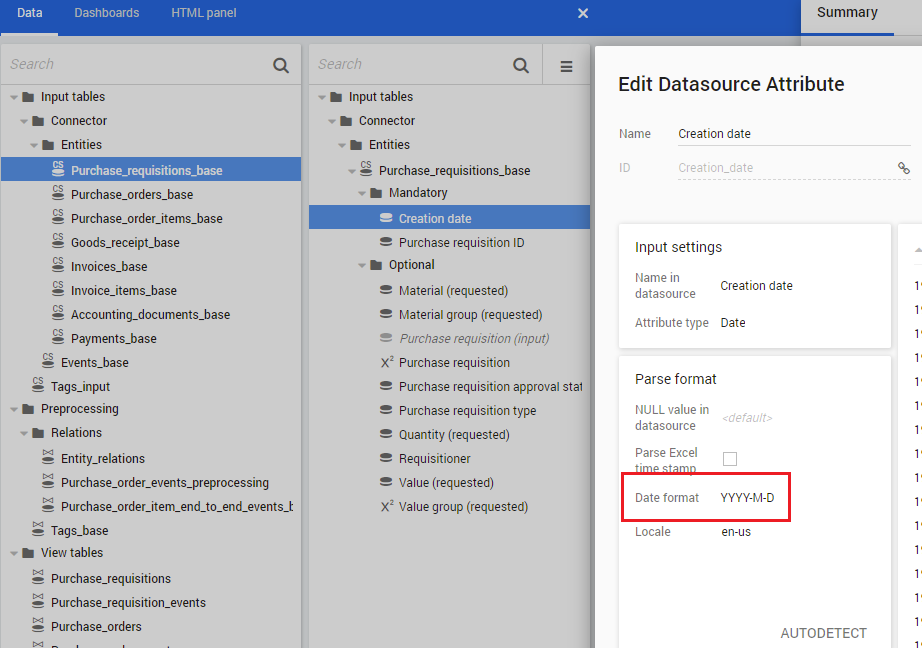
If your input data is of a different format than the default format in the Purchase-to-Pay Discovery Accelerator, you can edit the format settings for all the input attributes of that type in the Edit Datasource Attribute dialog in the Purchase-to-Pay Discovery Accelerator to match the format of your input data. See the illustration below for an example.
Changing the display format
If you want to use different display formats in the Purchase-to-Pay Discovery Accelerator than the default format that is set for the attribute type, you can change the display format settings in Purchase-to-Pay Discovery Accelerator. For example, if you want to use a different currency string you can change the settings in the Display Format dialog.
Follow these steps to open the Display Format dialog.
| Step | Action |
|---|---|
| 1 | Click on the Home button and select Settings.... |
| 2 | Click on DISPLAY FORMAT.... |
See the illustration below.
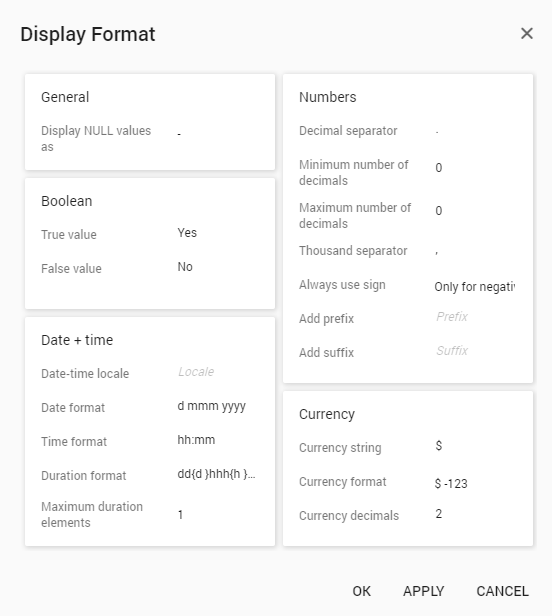
In a similar way, you can change the decimal separator or thousand separator for specific attributes.
For more information see Display Format.
- Introduction
- Purchase Requisition
- Purchase_requisitions_base Table
- Purchase Order
- Purchase_orders_base Table
- Purchase_order_items_base Table
- Goods_receipt_base
- Invoice
- Invoices_base Table
- Invoice_items_base Table
- Accounting
- Accounting_documents_base Table
- Payment
- Payments_base Table
- Events
- Events_base Table
- Activity Code
- Attribute Type
- Input Format