
- Introdução
- Melhores práticas
- Tenant
- Sobre o contexto do tenant
- Pesquisa de recursos em um tenant
- Gerenciamento de robôs
- Conectar Robôs ao Orchestrator
- Armazenamento de credenciais do robô no CyberArk
- Armazenamento de senhas do Unattended Robot no Azure Key Vault (somente leitura)
- Armazenamento de credenciais do Unattended Robot no HashiCorp Vault (somente leitura)
- Armazenando credenciais de Unattended Robots no AWS Secrets Manager (somente leitura)
- Exclusão de sessões não assistidas desconectadas e não responsivas
- Autenticação do robô
- Autenticação de robôs com credenciais de cliente
- Autenticação do SmartCard
- Auditar
- Configurações - Nível do tenant
- Serviço Catálogo de recursos
- Contexto de Pastas
- Automações
- Processos
- Trabalhos
- Gatilhos
- Logs
- Monitoramento
- Filas
- Ativos
- Armazenar Buckets
- Teste do Orquestrador
- Outras configurações
- Integrações
- Robôs Clássicos
- Gerenciamento de robôs
- Status do robô
- Exemplos de configuração
- Trabalhos
- Gatilhos
- Recursos
- Administração do host
- Sobre o nível do host
- Gerenciamento dos administradores do sistema
- Gerenciando Tenants
- Configurando notificações de e-mail do sistema
- Logs de auditoria para o portal do host
- Modo de Manutenção
- Administração da organização
- Solução de problemas
Esta página descreve um mapeamento entre vários cenários da vida real e a configuração correspondente do Orchestrator feita em pastas clássicas.
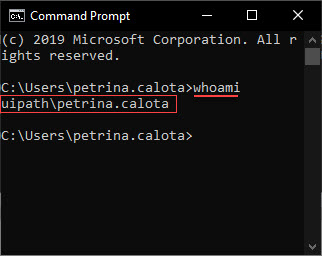
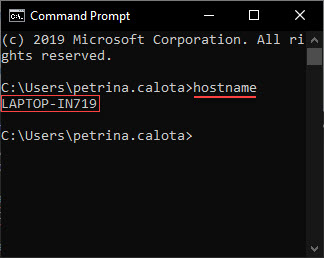
Antes de prosseguir para o mapeamento, leia primeiro como localizar o nome do usuário (e domínio, se for o caso) em que você está logado com sua máquina, e como localizar o nome máquina em si.
| Localizar o nome do usuário | Encontrar o nome da máquina |
|---|---|
|
Para exibir o domínio e o nome do usuário, siga os seguintes passos:
|
Para exibir o nome da máquina, siga os seguintes passos:
|

Em pastas clássicas, você só pode configurar configurações flutuantes do tipo assistido. Para configurações flutuantes não assistidas, migre para pastas modernas.
ilustrativos modernos
Combinação de um usuário/máquina
John recebeu um laptop da empresa para a qual ele trabalha, dia após dia.
Ele faz logon em seu laptop usando suas credenciais.
O identificador exclusivo (nome da máquina) do laptop é JOSMITH.
| Configuração na vida real |
|---|
| 1 usuário Uma máquina Combinação de usuário/máquina - permanece igual dia após dia. |
| Configuração flutuante do Orchestrator |
|---|
| One machine template. Its name is not relevant. One floating robot for the user. The robot is identified by John (using the domain\username syntax).John conecta seu UiPath Robot ao Orchestrator usando a chave gerada pelo modelo da máquina. |
| Configuração padrão do Orchestrator |
|---|
| One standard machine defined using the exact name of John's workstation, namely JOSMITH. One standard robot for the user/machine combination. The robot is identified by John (using the domain\username syntax), and John's machine (using the standard machine entity created above).John connects his UiPath Robot to Orchestrator using the key generated by the standard machine named JOSMITH. |
Combinações de dois usuários/máquina
Boris e Vadim trabalham como operadores de call center. Eles trabalham em dois turnos no mesmo computador.
Cada um deles faz logon no computador usando suas credenciais.
O identificador exclusivo do laptop é PC345.
| Configuração na vida real |
|---|
| Dois usuários Uma máquina Combinações de dois usuários/máquina — permanecem as mesmas dia após dia: {(Boris - PC345), (Vadim - PC345)}. |
| Configuração flutuante do Orchestrator |
|---|
| One machine template. Its name is not relevant. Two floating robots. Tanto Vadim quanto Boris conectam seus UiPath Robots ao Orchestrator usando a chave gerada pelo modelo da máquina. |
| Configuração padrão do Orchestrator |
|---|
|
One standard machine defined using the exact name of the workstation, namely PC345. Two standard robots, one for each user/machine combination.
Both Vadim and Boris connect their UiPath Robots to Orchestrator using the key generated by the standard machine named PC345. Each standard robot needs to be defined using the respective standard machine. To retain the Type and Machine fields while creating the robots, enable the Create Another check box. Alternatively, for an already existing robot click More Actions > Duplicate. |
Combinações de três usuários/máquina
Randy, Kanye e Juanita trabalham em máquinas virtuais, em imagens de área de trabalho virtual persistentes, que são entregues aos dispositivos de ponto de extremidade por uma rede. Cada um deles usa a mesma VM dia após dia.
Cada um deles faz logon nas VMs usando suas credenciais.
The unique identifiers of the VMs are: RAND32,KAN43 and JUA65
| Configuração na vida real |
|---|
| Três usuários Três máquinas 3 user/machine combination which stay the same day after day: {(Randy - RAND32), (Kanye - KAN43), (Juanita - JUA65) |
| Configuração flutuante do Orchestrator |
|---|
| One machine template. Its name is not relevant. Three floating robots. Cada usuário conecta seus UiPath Robots ao Orchestrator usando a chave gerada pelo mesmo modelo de máquina. |
| Configuração padrão do Orchestrator |
|---|
|
Three standard machines defined using the exact name of the workstations, namely RAND32,KAN43 and JUA65. Three standard robots, each for one user/machine combination.
Cada usuário conecta seu UiPath Robot ao Orchestrator usando a chave gerada pela máquina padrão com o mesmo nome que sua estação de trabalho. Each standard robot needs to be defined using the respective standard machine. To retain the Type and Machine fields while creating the robots, enable the Create Another check box. Alternatively, for an already existing robot click More Actions > Duplicate. |
Combinações de nove usuários/máquina
Ion, Sandu e Georgeta trabalham em máquinas virtuais, em imagens de área de trabalho virtual não persistentes, que são entregues aos dispositivos de ponto de extremidade por uma rede. Todo dia, uma VM de um pool três VMs é atribuída arbitrariamente a eles.
Cada um deles faz logon nas VMs usando suas credenciais.
The unique identifiers of the VMs are: VM10,VM11,VM12.
| Configuração na vida real |
|---|
| Três usuários Três máquinas 9 user/machine combinations which are random {(Ion - VM10), (Ion - VM11), (Ion - VM12), (Sandu - VM10), (Sandu - VM11), (Sandu - VM12), (Georgeta - VM10), (Georgeta - VM11), (Georgeta - VM12) |
| Configuração flutuante do Orchestrator |
|---|
| One machine template. Its name is not relevant. Three floating robots. Cada usuário conecta seus UiPath Robots ao Orchestrator usando a chave gerada pelo mesmo modelo de máquina. |
| Configuração padrão do Orchestrator |
|---|
|
Three standard machines defined using the exact name of the workstations, namely VM10,VM11,VM12. Nine standard robots, each for one user/machine combination.
Cada usuário conecta seus UiPath Robots ao Orchestrator usando a chave gerada pela máquina padrão com o mesmo nome que a sua VM. Each standard robot needs to be defined using the respective standard machine. To retain the Type and Machine fields while creating the robots, enable the Create Another check box. Alternatively, for an already existing robot click More Actions > Duplicate. |